


Why payer networks, reimbursement, and patient complexity are prolonging hospital stays.
Hospitals across the country face a familiar problem: patients who are medically ready for discharge but have nowhere appropriate to go.
Skilled nursing facilities (SNFs) provide post-acute nursing and rehabilitation services for patients who no longer require hospital-level care but still need skilled services before returning home or transitioning to another care setting. They are a substantial component of the healthcare system: in 2023, approximately 1.6 million Medicare-covered SNF stays accounted for $30 billion in fee-for-service Medicare and beneficiary spending (MedPAC, 2025).
SNFs are essential to patient flow, yet an available bed does not always translate into a viable discharge destination. Placement depends on whether a facility participates in the patient's payer network, can meet the patient's clinical needs, has appropriate staffing, and can accept the patient under applicable reimbursement and authorization arrangements. When these conditions delay or prevent transfer, patients remain hospitalized beyond medical readiness.
Hospitals across the country face a familiar problem: patients who are medically ready for discharge but have nowhere appropriate to go. A patient may be ready for transfer, and a facility may have an available bed. Yet placement also depends on payer network participation, the facility's ability to manage the patient's clinical needs, and reimbursement and authorization arrangements. When these conditions prevent or delay placement, patients remain hospitalized beyond medical readiness.
Hospitals across the country face a familiar problem: patients who are medically ready for discharge but have nowhere appropriate to go.
the payer-network disconnect
A health plan may list numerous contracted SNFs, but network size on paper says little about which facilities can accept a particular patient today. In a 2025 study, Medicare Advantage (MA) SNF networks included an average of 48.9% of facilities in the markets studied. (Marr and Meiselbach, 2025). A bed at an out-of-network facility may be inaccessible without additional approvals or agreements. Even an in-network facility may lack an appropriate staffed bed or necessary clinical services.
why an SNF may decline a referral
Admission decisions reflect a combination of clinical suitability, staffing, equipment, and reimbursement. Patients needing complex wound treatment, dialysis coordination, isolation capacity, behavioral health support, costly medications, or specialized bariatric care may be more difficult to place when local facilities lack adequate resources. Reimbursement arrangements may further influence admission decisions when the cost of meeting a patient's care needs exceeds what a facility can reasonably support under the applicable payment terms. Staffing is itself a capacity constraint: KFF reported an average of 3.85 nursing hours per resident per day in July 2025, down from 4.13 in 2015 (Chidambaram and Burns, 2025).
authorization can compound the delay
Even when a clinically suitable facility agrees to consider a patient, payer authorization may slow or prevent transfer. In a 2026 federal Office of Inspector General review of 19 Medicare Advantage organizations, 12% of SNF admission authorization requests in June 2024 were initially denied. Eighteen percent of denials were appealed, and 95% of appealed denials were overturned. (HHS-OIG, 2026). These findings raise questions about the consistency of initial authorization decisions and the consequences for patients whose denials are never appealed.
hospitals bear the consequences
As placement stalls, patients remain in acute-care beds despite no longer needing that level of service. The effects extend beyond the individual discharge: longer stays reduce bed availability, complicate emergency department flow, delay admissions, and increase exposure to hospital-related complications and deconditioning.
These delays also have financial consequences. Research on hospital patient-flow interventions has demonstrated opportunities to reduce length of stay and improve operational efficiency, with potential financial benefits depending on the costs avoided and the value of capacity released (Gonçalves-Bradley et al., 2022; Al Harbi et al., 2024).
A 2026 JAMA Network Open study of 3.34 million Medicare hospitalizations discharged to SNFs found that higher SNF nursing staffing within hospital-SNF markets was associated with shorter hospital length of stay (Prusynski et al., 2026). Although the study establishes an association rather than causation, it reinforces the operational relationship between post-acute staffing capacity and hospital throughput.
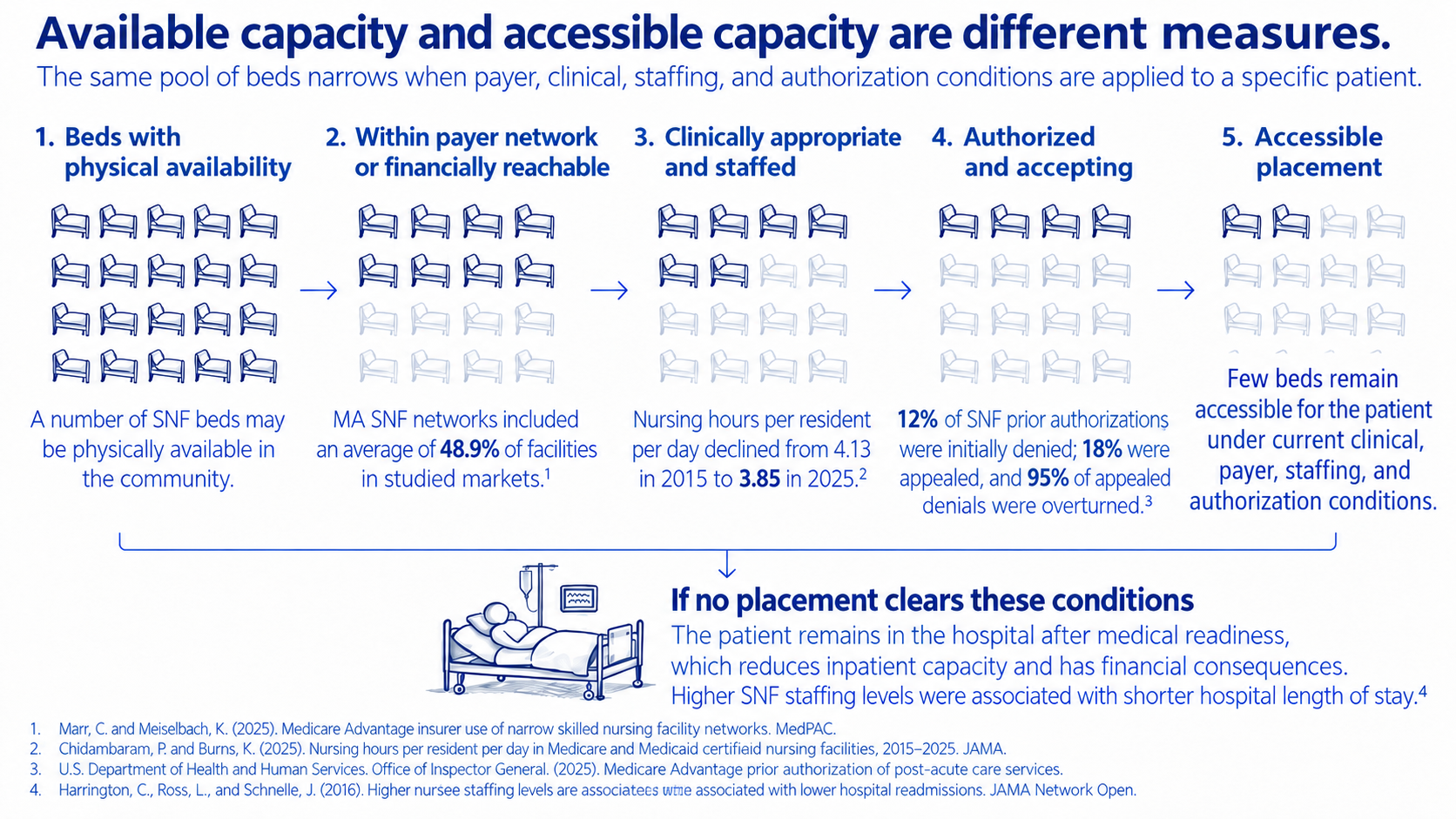
measure accessible capacity, not just available capacity.
Too often, the problem is labeled a hospital discharge-planning failure. But a case management team cannot create a payer contract, manufacture staffed capacity, or change the economics of an SNF admission. Health plans, hospitals, and post-acute providers should jointly measure referral acceptance rates by payer, reasons for declined referrals, authorization turnaround times, and hospital days extending beyond medical readiness. These measures can help distinguish nominal bed availability from the capacity patients can actually access. Contracting and payment arrangements should also account for the clinical complexity and resource requirements of the populations served.
available capacity and accessible capacity are different measures.
A facility may have an open bed, yet access depends on the alignment of clinical capability, staffing, payer arrangements, and authorization. Until hospitals, health plans, and post-acute providers measure and address these conditions together, discharge delays will continue to be managed within hospitals even when their causes extend across the healthcare system.
A facility may have an open bed, yet access depends on the alignment of clinical capability, staffing, payer arrangements, and authorization. Until hospitals, health plans, and post-acute providers measure and address these conditions together, discharge delays will continue to be managed within hospitals even when their causes extend across the healthcare system.
An available bed is not necessarily an accessible bed. Until we distinguish the two, we will continue treating a systemwide access problem as a hospital discharge problem.
Where is discharge access limiting your hospital's capacity?
Symbio Strategies works with healthcare leaders to examine post-acute placement barriers, payer authorization delays, and the clinical and financial consequences of extended hospital stays. To discuss your organization's patient-flow challenges with Dr. Ednann Naz and our clinical transformation team, contact in*******@**************es.com.
Author info:
Ednann Naz, MD, MPH, MBA
Physician Executive | Clinical Operations + Mid-Revenue Cycle
Ednann focuses on connecting clinical operations, utilization management, and mid-revenue cycle to help health systems strengthen care delivery and performance.
Mark Kestner, MD, MBA
Physician Executive | Clinical Operations + Health System Transformation
Mark specializes in operational redesign, clinical integration, and quality improvement, and leads the design and development of the clinical transformation domain.
Steph Sharma, DBA, G-MBA
Founder, Symbio Strategies
Steph advises senior leaders in healthcare, leadership governance, and decision systems. She founded the company in 2011, with a rebrand in 2018.
references
Al Harbi, S. et al. (2024) ‘Streamlining patient flow and enhancing operational efficiency through case management implementation’, BMJ Open Quality, 13(1), e002484. https://doi.org/10.1136/bmjoq-2023-002484. Chidambaram, P. and Burns, A. (2025) ‘A look at nursing facility characteristics in 2025’, KFF, 17 December. Available at: https://www.kff.org/medicaid/a-look-at-nursing-facility-characteristics/ Gonçalves-Bradley, D.C. et al. (2022) ‘Discharge planning from hospital’, Cochrane Database of Systematic Reviews, 2022(2), CD000313. https://doi.org/10.1002/14651858.CD000313.pub6 Marr, J. and Meiselbach, M.K. (2025) ‘Medicare Advantage networks for postacute care facilities’, Journal the American Geriatrics Society, 73(10), pp. 3266–3268. https://doi.org/10.1111/jgs.19612 Medicare Payment Advisory Commission (MedPAC) (2025) Report to the Congress: Medicare Payment Policy. Washington, DC: MedPAC. Available at: https://www.medpac.gov/wp-content/uploads/2025/03/Mar25_MedPAC_Report_To_Congress_SEC.pdf Prusynski, R.A., Yan, Z., Zachrison, K.S., Mroz, T.M., Hsia, R.Y. and Sabbatini, A.K. (2026) ‘Skilled nursing facility network capacity and hospital length of stay’, JAMA Network Open, 9(4), e269930. https://doi.org/10.1001/jamanetworkopen.2026.9930 U.S. Department of Health and Human Services, Office of Inspector General (HHS-OIG) (2026) Medicare Advantage organizations overturned nearly all appealed prior authorization denials for skilled nursing facility admission, raising concerns about initial denials. Report OEI-09-24-00331, June. Available at: https://oig.hhs.gov/reports/all/2026/medicare-advantage-organizations-overturned-nearly-all-appealed-prior-authorization-denials-for-skilled-nursing-facility-admission-raising-concerns-about-initial-denials/ March of Dimes (2026) Nowhere to Go: Maternity Care Deserts Across the U.S. 2026