

You are considering implementing a change initiative. The need is clear and financial resources are available. Are you ready? Do you have everything you need and should you move forward with implementation?
The change could be AI integration, a restructure, a revised workflow, or another kind of change. Each requires the same assets to succeed: internal leadership capacity that can accurately assess organizational readiness and lead the organization through the process, navigating the unpredictable challenges that are bound to surface during implementation while sustaining the changes over time.
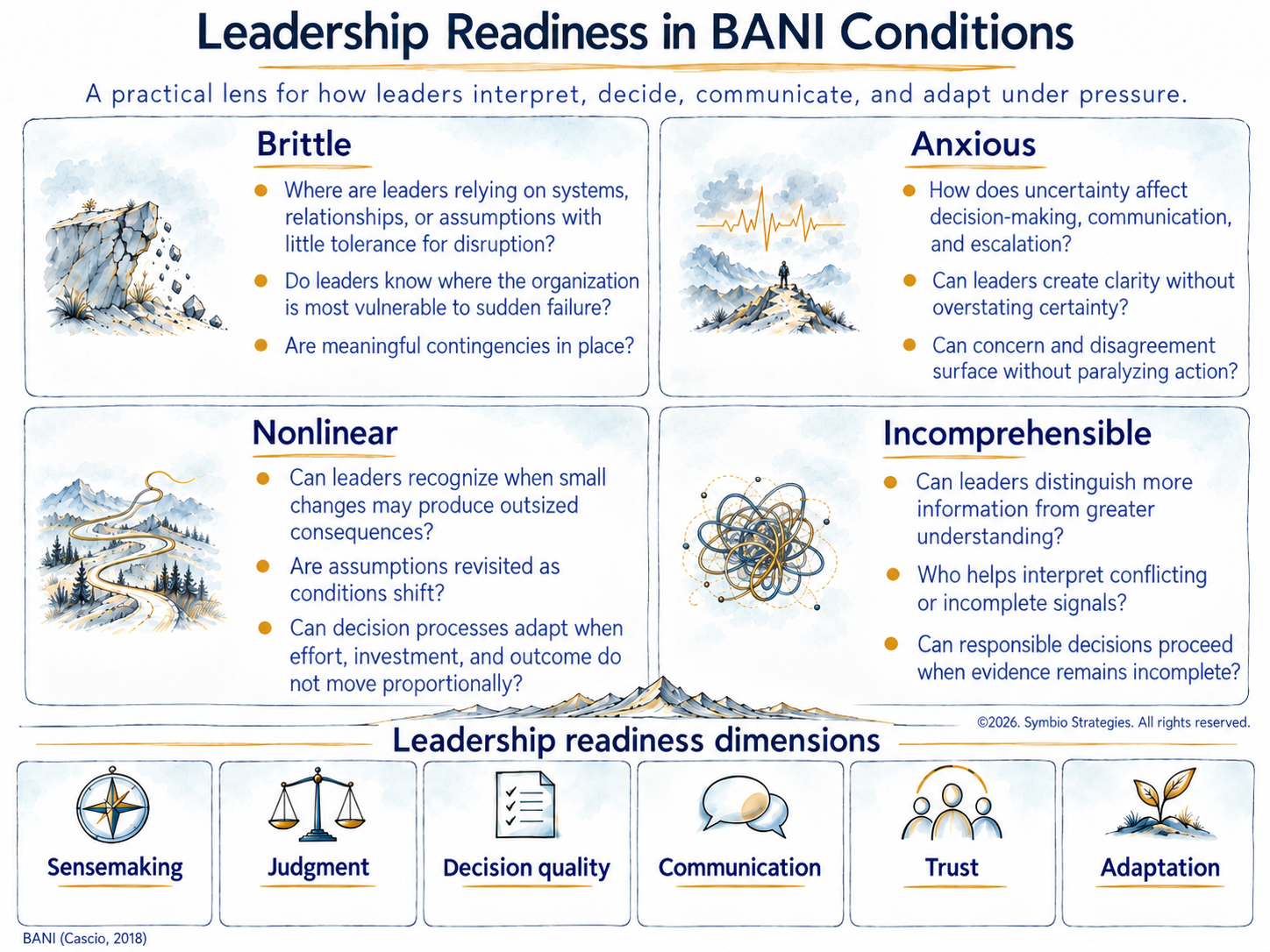
One might think, “Well, challenges aren’t anything new. We have implemented change in VUCA (Volatile, Uncertain, Complex, and Ambiguous) environments for decades.” A more recent proposed framework suggests that we need a different model to understand and operate in today’s global environment. While VUCA probably still rings true for most of us, this framework proposes that we have entered an age of BANI: Brittle, Anxious, Nonlinear, and Incomprehensible (Cascio, 2020). BANI helps highlight how complex demands reside with organizational leaders.
So why is mastery in these areas required now? And are leaders themselves ready to lead change through to lasting results?
After reading this article top-level leaders will be better able to assess organizational readiness before investing significant resources into a change project that will not be sustained long term and fully integrated into daily operations. Thorough assessment of readiness extends beyond securing funding, project management and human capital for implementation. The most critical asset needed for successful organizational change is leadership capacity. Leaders not only need specific knowledge and skills, but also awareness of broader, external circumstances and conditions that could dramatically impact their change initiative. We will begin to explore these conditions and the impact on the leadership capacity required to maintain and integrate long term change.
The Foundation for Lasting Results
Steph Sharma, founder of Symbio Strategies, offers a visual framework for assessing organizational readiness in her article “Rethinking Readiness,” (Sharma, 2026). Readiness is specific to the change, and it is also specific to the leaders responsible for the process. Many of the challenges facing senior teams today are about capacity.
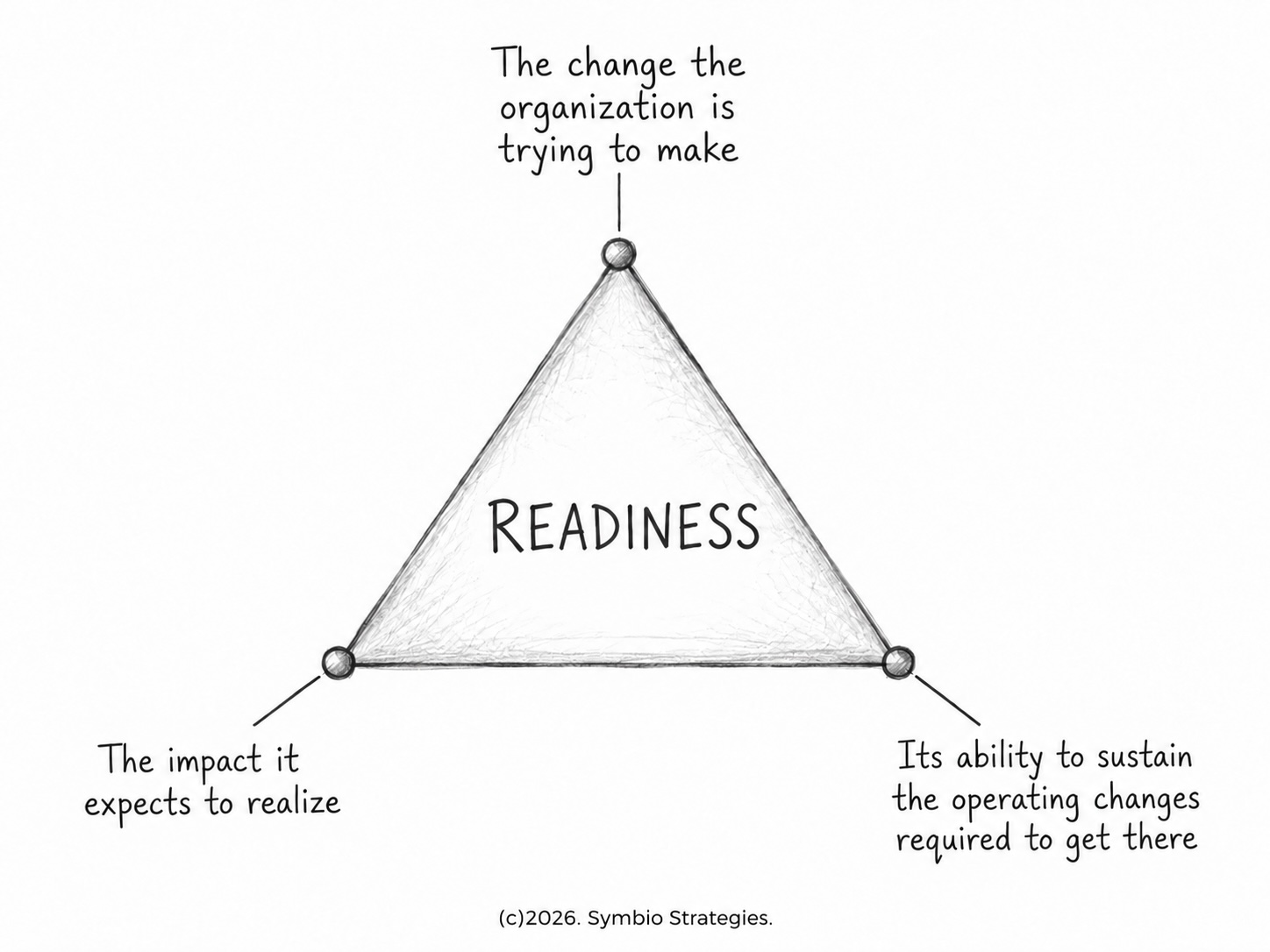
Sharma describes Symbio Strategies’ “Step 0” and how it is used to assess organizational readiness for change. This step evaluates “the need being addressed, leadership and operating readiness, current technology and data, available investment, and what will be required to sustain the change.”Effective leaders can develop a vision that embraces impermanence and can operate in an environment of continuous, urgent iteration.
Many of the challenges facing senior teams today are about capacity.
Four Capacities for Leading in Evolving BANI Environments
The rapid expansion and widespread adoption of generative and agentic AI, along with the demands of working and succeeding in BANI environments, take an emotional and intellectual toll on the entire organization and the ecosystem in which it operates.
AI integration promises greater efficiency, significant cost reduction, increase in profits among a host of other benefits to the organization. While these may be realized (or not) AI integration comes with a cost that is less obvious. When employees source their own AI tools without their organization’s guidance, their usage creates risks that employers aren’t aware of. (Qualtrics 2026) Extensive AI use can lead to weakening our cognitive muscles leading to “cognitive debt”. (MIT Management School 2026) And these are just a couple.
It is no longer enough for leaders to inspire, engage, and retain their workforce. Leaders need to create a sense of calm in conditions that rival navigating a hurricane in quicksand.
Leaders implementing and managing organizational change in BANI environments need mastery in four key areas:
- Build trust that holds under tension 2008) (Brittle)
- Lead yourself from your values (Anxious)
- Lead the system, not just the people (Nonlinear)
- Communicate with clarity and transparency (Incomprehensible)
Implications for Early-stage Organizations
The implications for top-level leaders in early-stage organizations are significant. In these organizations, leaders are the operating system. There is not yet a middle management layer to add to the organization’s leadership capacity or to translate and implement change throughout the organization. Institutional knowledge, key internal and external relationships, resources, and the decision-making authority needed to move change forward all reside with a few people. A key component of readiness, then, is the bandwidth these individuals have to lead and manage the full scope of the change. Whether it’s a health system or a 15-person nonprofit, the leaders who approved the change are the same ones who have to manage it and see it through.
Astute leaders consider the impact a change will have on others in the organization’s ecosystem, especially those who contribute to their human capital. Organizational change can lead to unintended consequences for collaborators, partners, suppliers or the surrounding community. Even if the change achieves its intended result, what is the effect on staff who may already be stretched and stressed by the BANI landscape? Because early-stage organizations often have less human capital, unintended effects on limited resources can have significant consequences. Change in emerging organizations requires lasting behavior change, not only among staff but, most importantly, within the executive team, who need to model, coach, and mentor that change. This capacity should be assessed early in the readiness phase, because without it, the change won’t be sustained.
Change rarely happens in isolation, especially organizational change, so even early-stage enterprises should approach it from a systems perspective. Every choice, action (or inaction), decision, etc. impacts the greater whole. For an organization, for example, that means a new policy in accounting might impact patient care or business hours of operations impacts who is able to access services at a clinic.
A change in one part of the system can alter responsibilities, decisions, resources, and relationships elsewhere.” (Sharma, 2026)
Sustaining performance requires more than meeting today's demands.
Because systems change is dynamic, iterative, and unpredictable (Meadows, 2008), a readiness assessment should examine top leaders’ ability and openness to accept shifts that affect not only others but also their own responsibilities, roles, decision-making authority, and power within the organization.
Can your leaders continue to lead from their values, stay adaptable, regulate their emotional expression, and remain mindful of the impact their behavior and leadership have on the organization?
“Organizational change triggers predictable psychological responses at every level, from the C-suite to the shop floor, with anxiety, burnout and depression among the risks.” Paul Litchfield, a medical adviser, goes on to discuss the phases of organizational change and points out that the human side of change is at the heart of failed change initiatives. (Litchfield, 2026)
It’s not uncommon for people going through organizational change to feel anxious and helpless, to have trouble sleeping, and to experience physical symptoms such as an increased heart rate, dizziness, and difficulty concentrating. (Shields, et al., 2016). As Litchfield notes, senior leaders, including the C-suite, are not immune to the psychological stress that change often brings. While these effects are concerning, the effect of stress on the brain’s executive functioning is even more concerning (Shields, et al., 2016) Sustained, high, or uncontrollable stress tends to weaken cognitive flexibility and working memory, although the effect varies by person and situation. Moderate pressure can sharpen focus, but sustained, unrelenting pressure tends to narrow thinking and pull leaders toward reactive decisions (Starcke and Brand, 2016) (Arnsten, 2009) (Arnsten, 2015).
How executive leaders perform in high-stress, high-pressure situations directly affects the success of change initiatives. “Leadership contributes 71% of the success of change amongst employees.” (Khaw, et al., 2022). Strong performance under pressure requires adaptive capacity, which depends on leaders who can take in new information without becoming defensive and adjust quickly During organizational change, especially in BANI environments, new information often emerges and market or socioeconomic conditions shift. Effective leaders need the capacity to be flexible, discerning, and creative as they navigate these factors. Readiness assessments only help if leaders bring the discernment and decision-making ability to act on what they find.
Leaders who cannot self-regulate or build authentic relationships at work may struggle to generate the goodwill, trust, collaboration, and confidence needed to lead their organizations, departments, or teams through a complex change. Leaders who can lead themselves and build solid, trusting working relationships that weather tension and strain are better positioned to lead others (Martins, Ramalho, & Morin, 2010) (Walsh & Arnold, 2018) (Cohen & Wills, 1985). Transformational and creative leadership styles help foster positive feelings about the change among employees, and leaders who use them have the relationship capital to support staff through the process (Khaw 2022)
Below are a few questions to help senior leaders assess the leadership capacity of their team members to overcome the challenges present in BANI environments.
- When conditions feel unpredictable or overwhelming, do our leaders recognize their own anxiety and understand how it shapes their decisions, or does it show up as control, avoidance, or urgency? [Anxious]
- Have our leaders developed relationships strong enough to absorb a sudden shock (a funding cut, a failed rollout, a public setback) without the team fracturing or weakening? [Brittle]
- Do staff trust their leader enough to stay engaged when the leader cannot yet tell them what will happen? [Anxious, Incomprehensible]
- Can our leaders identify where the organization seems stable but is actually fragile, such as single points of failure, overextended people, or processes that only work under ideal conditions? [Brittle]
- Do our leaders recognize that small decisions can have large effects elsewhere in the system, and check for ripple effects or unintended consequences before acting? [Nonlinear]
- Can our leaders communicate honestly about what is unknown while still giving people enough clarity and steadiness to keep moving? [Anxious, Incomprehensible]
- Are our leaders willing to make and own decisions with incomplete information, then adjust openly when new information emerges? [Nonlinear, Incomprehensible]
- When the situation is too complex for any one person to understand, do our leaders draw on diverse perspectives to make sense of it, rather than defaulting to their own interpretation?
Pausing as a Leadership Decision
Sometimes the best course for a change effort is to pause and accept that the organization isn’t ready yet. The courage to narrow the scope, resequence the work, or pause entirely, despite pressure to keep going, is a leadership capacity. Strong, trusting relationships allow leaders to build support for slowing the process down and, potentially, to avoid the fallout of a failed change initiative later.
Deciding when to proceed with change effort is an important decision in any organization, and especially in early-stage organizations. Everyone involved in the process needs the courage to voice dissent and concerns, challenge decision-makers, and act on their values. Collaborative decisions depend on trust that holds under tension and pressure. No one person can see the whole picture, especially in BANI environments, which is why a collaborative approach to decision-making has advantages (Weiner, 2009).
So how do you know whether your leaders have the key capacities to lead a successful change initiative? Symbio’s Step 0 assessment answers this question. Below are some of the questions we seek to answer through the assessment.
- What is my own relationship to this change, and am I willing to act on our values when the call is hard, including saying “not yet” (Dweck, 2006)?
- Do our people trust us enough to tell us what is not working, and can we disagree openly as a leadership team and across the organization?
- Can we explain what is changing, why, what we do not know yet, and who makes the final decision?
- What else will move when this changes, and who holds decision rights as it does? What is the impact of this change on members of our ecosystem? Could a broader or deeper coalition strengthen this change? Who could be negatively affected or harmed by these changes?
Invitation
Leadership capacity is also an outcome to measure at three, six, and twelve months into implementation. Where has it been strongest, and where have gaps emerged? This information is valuable for longer change initiatives and for preparing for future organizational change.
We would welcome a deeper discussion to customize a solution for your organization or serve as a thought partner as you explore your next steps. Our imperative is sustainability – long-term after we and all solution architects have left. As a research-based knowledge organization, we welcome the sharing of experiences and knowledge in assessing organizational readiness for change.
At Symbio Strategies, we work with leaders to assess these capacities not only at the executive level but also across teams, and all areas of the organization.
Tanya
Symbio Strategies’ Leadership & Decision Systems practice, integrates leadership development, executive and team effectiveness, and organizational systems design to strengthen how leaders navigate complexity, make consequential decisions, coordinate action, and build the capacity to sustain change.
contact in*******@**************es.com.
Author info:
Tanya Bluford
Leadership Development | Organizational Culture Consultant
Tanya works with leaders and organizations to strengthen leadership capacity, organizational culture, and the conditions that support alignment and effective execution.
references
Arnsten AF. Stress signalling pathways that impair prefrontal cortex structure and function. Nat Rev Neurosci. 2009 Jun;10(6):410-22. doi: 10.1038/nrn2648. PMID: 19455173; PMCID: PMC2907136.
Arnsten AF. Stress weakens prefrontal networks: molecular insults to higher cognition. Nat Neurosci. 2015 Oct;18(10):1376-85. doi: 10.1038/nn.4087. Epub 2015 Sep 25. PMID: 26404712; PMCID: PMC4816215.
Cascio, J. (2020, April 29). Facing the Age of Chaos. https://medium.com/@cascio/facing-the-age-of-chaos-b00687b1f51d
Khaw KW, Alnoor A, Al-Abrrow H, Tiberius V, Ganesan Y, Atshan NA. Reactions towards organizational change: a systematic literature review. Curr Psychol. 2022 Apr 13:1-24. doi: 10.1007/s12144-022-03070-6. Epub ahead of print. PMID: 35431526; PMCID: PMC9006211.
Cohen S, Wills TA. Stress, social support, and the buffering hypothesis. Psychol Bull. 1985 Sep;98(2):310-57. PMID: 3901065.
Dweck, C.S., 2006. Mindset: The new psychology of success. New York: Random House.
Kruse, K. Contributor (2025, February 3). Forget VUCA. The World Is BANI Now. https://www.forbes.com/sites/kevinkruse/2025/02/03/forget-vuca-bani-is-the-new-framework-world/
Litchfield, P. (2026, May 19). Why managing the human cost of organizational change is make or break. https://www.weforum.org/stories/wellbeing-and-mental-health/human-cost-organizational-change-make-or-break
Martins, A., Ramalho, N., & Morin E., (2010) ‘A comprehensive meta-analysis of the relationship between Emotional Intelligence and health, Personality and Individual Differences’, 49(6), pp. 554-564,ISSN 0191-8869, https://doi.org/10.1016/j.paid.2010.05.029.
Meadows, D.H., 2008. Thinking in systems: A primer. Edited by D. Wright. White River Junction, VT: Chelsea Green Publishing.
MIT Sloan Office of Communications. (2026, October 5). The hidden toll of frictionless tech: What AI does to our minds[Press release]. MIT Sloan School of Management. https://mitsloan.mit.edu/press/[paste-exact-URL]
Sharma, S. (2026, September 11). Rethinking Readiness. https://symbiostrategies.com/insights/
Shields, G., Sazma, M., & Yonelinas, A. (2016) ‘The effects of acute stress on core executive functions: A meta-analysis and comparison with cortisol’, Neuroscience & Biobehavioral Reviews, v68, pp. 651-668. doi.org/10.1016/j.neubiorev.2016.06.038.
Starcke, K., & Brand, M. (2016). Effects of stress on decisions under uncertainty: A meta-analysis. Psychological Bulletin, 142(9), 909–933.https://doi.org/10.1037/bul0000060.
Qualtrics. (2026). 2026 employee experience trends [Report]. https://www.qualtrics.com/ebooks-guides/employee-experience-trends/
Walsh M. and Arnold K. (2018) Mindfulness as a Buffer of Leaders’ Self-Rated Behavioral Responses to Emotional Exhaustion: A Dual Process Model of Self-Regulation. Front. Psychol. 9:2498. doi: 10.3389/fpsyg.2018.02498.
Weiner, B.J. (2009) ‘A theory of organizational readiness for change’. Implementation Science, 4, Article 67. doi: 10.1186/1748-5908-4-67.