


In the age of AI, health information exchange must evolve from moving records to delivering intelligence.
the payer-network disconnect
A patient arrives at the hospital with heart failure. She has been admitted twice elsewhere in the past six months. An outside echocardiogram showed an ejection fraction of 25%. Her baseline creatinine is 1.3 to 1.5. A medication was discontinued during a prior admission because of hypotension. Much of this information is electronically available. The health information exchange worked. The records are there. And then what happens?
A physician searches outside notes. A utilization-management nurse looks for evidence supporting the admission. A CDI specialist reviews clinical indicators. A coder checks diagnostic support. If the claim is denied weeks later, another team reconstructs the same history.
Health information exchange (HIE) enables the secure electronic sharing of patient information across healthcare organizations. Its purpose is to make clinical information available beyond the institution where it was originally recorded. Yet availability alone does not make that information easy to interpret or use.
We built extraordinary infrastructure to move information. Then we gave humans more information to read. That cannot be the endpoint It is no longer a question of whether we can get the records. But can we make sense of the information and actually do something useful with it?
A health plan may list numerous contracted SNFs, but network size on paper says little about which facilities can accept a particular patient today. In a 2025 study, Medicare Advantage (MA) SNF networks included an average of 48.9% of facilities in the markets studied. (Marr and Meiselbach, 2025). A bed at an out-of-network facility may be inaccessible without additional approvals or agreements. Even an in-network facility may lack an appropriate staffed bed or necessary clinical services.
HIEs do create value
Systematic reviews associate exchange with reduced duplicate testing, imaging, costs, and, in some settings, improved utilization and safety (Hersh et al., 2015; Menachemi et al., 2018). Research on repeat imaging illustrates the economic logic of making prior results visible (Jung et al., 2015). Yet evidence is heterogeneous, and infrastructure alone does not guarantee outcomes.
HIE has already demonstrated its value, but there is an opportunity to do much more. For years, the focus has been on making patient records accessible across healthcare organizations. Now we need to go further. Having access to information is one thing. Understanding what matters and using that information to make better decisions is another.
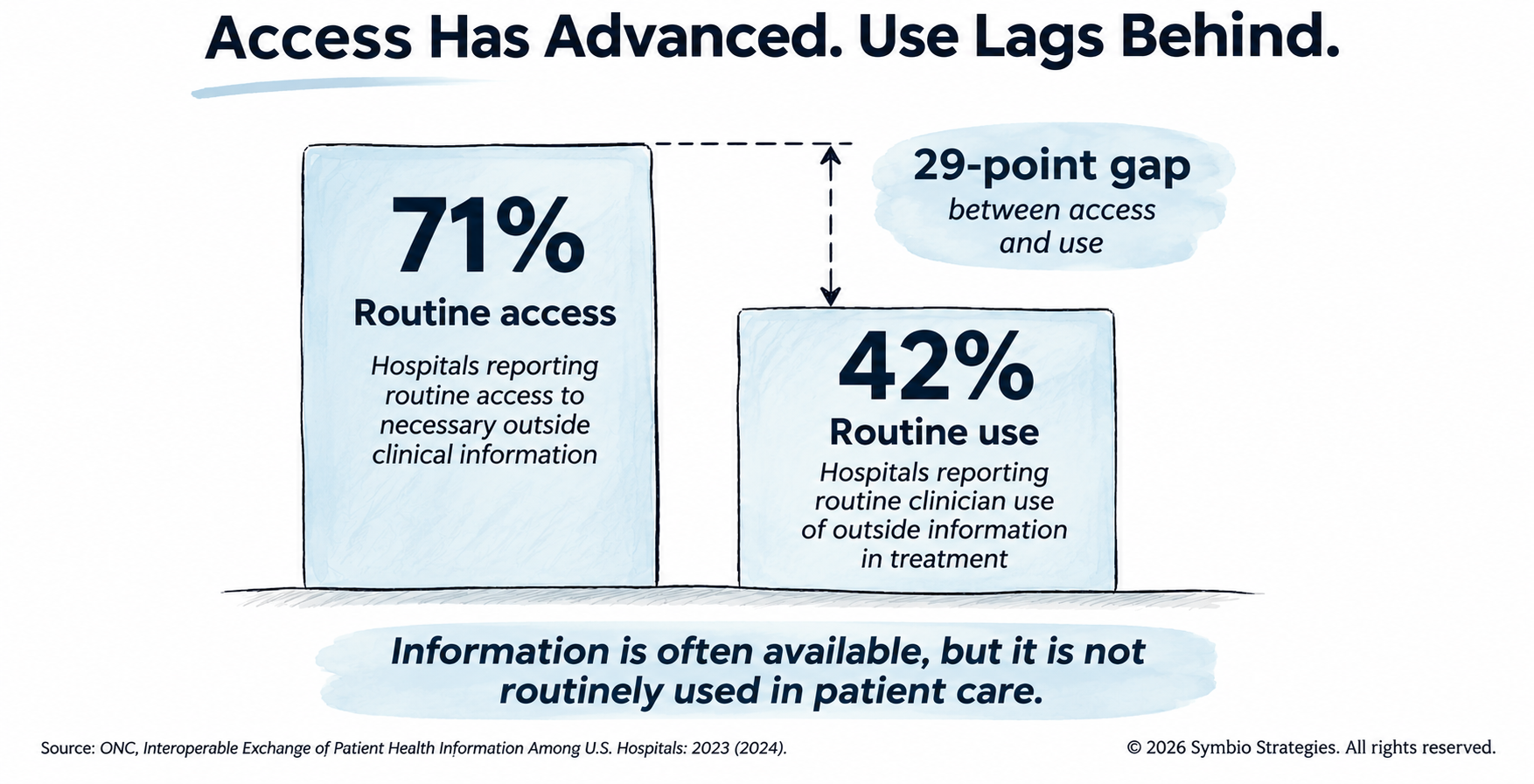
Connectivity has advanced. Usability remains a problem.
Federal interoperability data document substantial progress in hospitals’ ability to send, receive, find, and integrate external clinical information. Yet in 2023, 71% of U.S. non-federal acute care hospitals reported routine access to necessary clinical information from outside providers, while only 42% reported that clinicians routinely used such information when treating patients (ONC, 2024).
Significant achievements and yet technical availability is not comprehension, and comprehension is not action. A successful interface can deliver hundreds of pages without making a decision easier.
A hospital may receive a complete record while a clinician still struggles to locate the single prior test, treatment failure, or clinical baseline that is needed ‘now’.
hospitals bear the consequences
As placement stalls, patients remain in acute-care beds despite no longer needing that level of service. The effects extend beyond the individual discharge: longer stays reduce bed availability, complicate emergency department flow, delay admissions, and increase exposure to hospital-related complications and deconditioning.
These delays also have financial consequences. Research on hospital patient-flow interventions has demonstrated opportunities to reduce length of stay and improve operational efficiency, with potential financial benefits depending on the costs avoided and the value of capacity released (Gonçalves-Bradley et al., 2022; Al Harbi et al., 2024).
A 2026 JAMA Network Open study of 3.34 million Medicare hospitalizations discharged to SNFs found that higher SNF nursing staffing within hospital-SNF markets was associated with shorter hospital length of stay (Prusynski et al., 2026). Although the study establishes an association rather than causation, it reinforces the operational relationship between post-acute staffing capacity and hospital throughput.
The information may be available. That does not mean anyone has time to find it.
Where is discharge access limiting your hospital's capacity?
A 2024 Health Affairs analysis found that each additional hour physicians spent documenting was associated with a 7.1% reduction in the proportion of patients for whom available outside HIE records were viewed (Holmgren, Adler-Milstein and Apathy, 2024). This association exposes a critical tension: documentation workload competes with information retrieval.
Research on information overload, chart-review workload, and note bloat reinforces the point (Nijor et al., 2022; Kroth et al., 2019; Arndt et al., 2024).The challenge goes beyond information scarcity. Increasingly, it is attention scarcity. We can connect every hospital, but if access requires clinicians to search, scroll, compare, and reconstruct, we have solved the technical problem without fully solving the human one. The better we become at exchanging information, the more information we potentially give clinicians to review.
A longitudinal record may contain progress notes, consultations, problem lists, medication lists, imaging, laboratory results, ED notes, and discharge summaries. Some are relevant, some outdated, some copied forward, and some contradictory. Someone must still decide what actually happened.
If we replace a stack of paper charts with a stack of electronic charts that a human must reconstruct, how much of the underlying problem have we solved? We improved access, certainly. Access alone does not eliminate cognitive burden.
The discharge summary illustrates the problem perfectly
The discharge summary is essential, and it exposes the limits of manual reconstruction. A study of 7,185 discharge summaries found that 37.6% were released at least one day after discharge. Delayed release was also associated with increased 30-day readmission among medical patients (Kleinig et al., 2025). The diagnoses, medications, tests, procedures, and clinical events already exist electronically, yet a clinician must assemble another document for someone else to interpret.
The intent is to make them timely, accurate, contextual, and usable. Why must summarizing an electronically documented hospitalization remain such a manual cognitive task? Why must the recipient read the entire document simply to identify what changed?
AI changes the economics of finding information.
Computers have long been effective at transporting and retrieving data, but interpreting the clinical narrative across encounters has remained labor-intensive. Large language models create the possibility of extracting, comparing, organizing, and summarizing longitudinal records. Instead of “427 documents found,” an information exchange could help deliver a concise, role-specific account of what matters.
For example: three heart-failure-related acute encounters in six months; most recent EF 25%; baseline creatinine 1.3–1.5; a key medication discontinued for hypotension; no documented cardiology follow-up. Every assertion should link to its source, including the echocardiogram, discharge note, and laboratory measurements, with conflicting information or uncertainty made visible.
Research on verifiable, problem-oriented EHR summarization supports exploration of this source-linked approach (Verma et al., 2025). Summarization without provenance creates risk. Summarization with evidence can make chart review more efficient and auditable.
Early clinical evaluations caution against hype. An emergency-department study of integrated AI chart summarization reported mixed physician-level effects and no statistically significant overall reduction in review time. A generic summary is not necessarily the right summary.
The opportunity goes beyond simply “summarize this chart.” It is “tell me what I need to know to perform this particular job.” A clinician, coder, CDI specialist, physician advisor, care manager, and payer ask different questions of the same underlying record.
The answeris to make them timely, accurate, contextual, and usable. Why must summarizing an electronically documented hospitalization remain such a manual cognitive task? Why must the recipient read the entire document simply to identify what changed?
One patient record. Different questions.
Adding an AI summary button won’t solve the underlying problem. A 2026 JAMA Network Open study of EHR-integrated AI note summarization found no statistically significant overall reduction in emergency physicians’ record-review time, despite favorable usability assessments (You et al., 2026). A generic summary is not necessarily the right summary.
The opportunity goes beyond simply summarizing a chart. The system should tell me what I need to know to perform this particular job. A clinician, coder, CDI specialist, physician advisor, care manager, and payer ask different questions of the same underlying record.
To make this work, we need a longitudinal Patient Story: an account of the patient’s clinical conditions, trajectory, prior decisions, and treatment response that can be understood across settings and used to inform different decisions.
An emergency physician needs recent events that change immediate care. A hospitalist needs baseline function and what changed. A PCP needs medication changes, pending results, and follow-up. A CDI specialist needs evidence for conditions that may be incompletely documented. UM needs medical-necessity context. A coder needs clarification of ambiguous diagnoses and procedures. A denial team needs defensible evidence tied to the disputed issue.
The underlying patient information is the same. AI offers the prospect of converting one longitudinal record into several evidence-linked, role-specific views, with humans retaining judgment and responsibility.
Revenue cycle may be HIE’s most overlooked opportunity.
Many revenue-cycle disputes are disputes about the clinical story. Was inpatient care necessary? Was a diagnosis clinically supported? Had outpatient treatment failed? Was the condition acute? What was the patient’s baseline? Often, the most useful information comes from an earlier ED visit, an old echocardiogram, prior cultures, specialist notes, or serial laboratory results.
Yet revenue-cycle operations often treat the hospitalization as a discrete episode. The patient does not. The most important revenue-cycle evidence may exist before the patient ever enters the hospital. HIE may already contain it.
CMS’s Interoperability and Prior Authorization Final Rule, CMS-0057-F, requires affected payers to implement specified FHIR-based APIs and related processes on phased timelines (CMS, 2024). This does not mean payer decisions are already fully automated or that all clinical information can be freely reused. It does mean that structured information exchange is increasingly becoming part of authorization and reimbursement workflows.
Clinical data are becoming more interoperable. Payer requirements and decisions are becoming more structured. AI is becoming capable of interpreting both.
Why are clinical evidence and reimbursement decisions still treated as separate information systems?
Move revenue integrity upstream.
A claim is submitted. A payer questions a diagnosis or medical necessity. A denial arrives. A nurse, physician advisor, coder, or appeals specialist searches the chart, finds outside records, reconstructs severity, writes an appeal, and waits. An overturned denial may be a financial success, but operationally it is expensive rework.
We must look beyond how many denials can be overturned, and ask how many occur because evidence was never assembled, contextualized, or presented at the right moment. Industry frameworks identify medical necessity, clinical information, and related denial categories, but they do not establish how much AI-enabled HIE could reduce denials (HFMA, 2021). That outcome requires rigorous measurement. That outcome needs rigorous measurement.
For sepsis, longitudinal exchange might surface recent antibiotics, resistant organisms, prior cultures, and baseline organ function. For heart failure, it might surface EF trends, prior decompensations, and medication changes. For inpatient medical necessity, it might identify documented failures of outpatient treatment at another organization.
Clinical validation often asks whether the current encounter supports a diagnosis. A longitudinal record enables a richer question: does the patient’s trajectory support it? cute kidney injury assessment may require prior creatinine values; respiratory failure may require baseline oxygen needs; malnutrition may require historical weights; encephalopathy may require cognitive baseline; heart failure may require ejection fraction trends and prior treatment response.
This is longitudinal clinical validation: evidence from multiple encounters, presented with dates and provenance, used to support or challenge a clinical interpretation. The physician remains accountable for diagnosis, and any CDI query must remain compliant and nonleading.
The goal is not to manufacture diagnoses or to optimize coding independent of clinical truth. It is to make clinically relevant evidence available while decisions and documentation can still be improved, rather than discovering it weeks later during appeal.
The answeris to make them timely, accurate, contextual, and usable. Why must summarizing an electronically documented hospitalization remain such a manual cognitive task? Why must the recipient read the entire document simply to identify what changed?
The HIE should stop waiting to be queried.
Today, users log in, find a patient, open records, read documents, and interpret them. Tomorrow, events should trigger context-aware retrieval: admission prompts a summary of prior treatment failures; discharge prompts medication and follow-up changes; CDI review surfaces relevant clinical indicators; claim preparation flags missing support; a denial triggers an evidence map.
Making evidence available at the right moment is only part of the solution. Workflows must also establish who reviews it, who makes the decision, and who is responsible for the resulting action.
Not every alert should fire, and not every workflow needs automation. Relevance, timing, suppression of noise, and human review are essential. The goal is to stop using highly trained professionals as search engines.
The answeris to make them timely, accurate, contextual, and usable. Why must summarizing an electronically documented hospitalization remain such a manual cognitive task? Why must the recipient read the entire document simply to identify what changed?
Why are we not already doing this?
HIEs were built for exchange; EHRs for documentation; CDI for documentation integrity; UM for level-of-care decisions; RCM for claims; payer systems for adjudication. The patient crosses all these boundaries. Data normalization, matching, provenance, privacy, consent, contradictory information, model reliability, workflow integration, incentives, and governance remain significant obstacles.
Organizational silos are equally important. The CIO may own interoperability, the CFO revenue cycle, the CMO clinical quality, and separate teams CDI, HIM, UM, and care management. No one organizational chart owns the longitudinal patient story.
Without shared accountability for how clinical evidence moves across these functions, better information exchange may leave the underlying fragmentation intact.
The answeris to make them timely, accurate, contextual, and usable. Why must summarizing an electronically documented hospitalization remain such a manual cognitive task? Why must the recipient read the entire document simply to identify what changed?
AI makes provenance more important.
A black-box statement that a patient has acute systolic heart failure is not sufficient. Which echo? Which date? Which physician note? Is there contradictory evidence? A trustworthy system should make the assertion, supporting source, date, uncertainty, and clinical context visible.
AI should not replace chart review by hiding evidence. It should make review faster by making evidence easier to verify. Studies of AI chart review also report omissions and hallucination risks, supporting careful validation before deployment (Kahl et al., 2026).
Stop measuring HIE success by transactions.
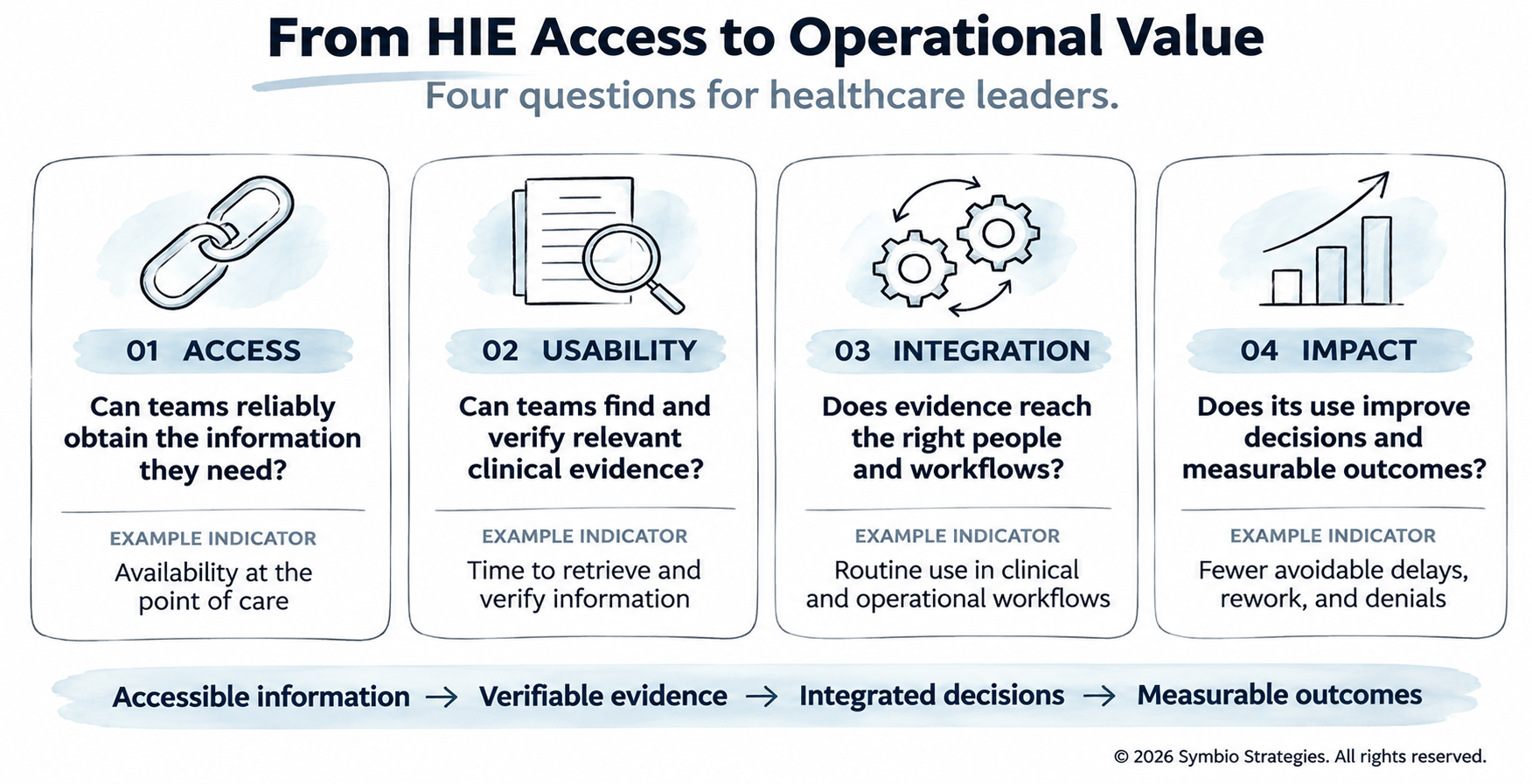
Participants, interfaces, queries, ADTs, CCDs, and documents exchanged show whether infrastructure works. They do not fully show whether care improved. More meaningful measures examine whether outside information improved clinical decisions, reduced unnecessary testing or chart-review time, supported care transitions, accelerated authorization, or helped prevent avoidable denials. These outcomes connect interoperability to clinical effectiveness, operational performance, and revenue integrity.
These outcomes must be measured against credible baselines, with attention to unintended effects and actual costs. The unit of HIE value should not simply be a transaction. It should be an action enabled by information.
AI should not replace chart review by hiding evidence. It should make review faster by making evidence easier to verify. Studies of AI chart review also report omissions and hallucination risks, supporting careful validation before deployment (Kahl et al., 2026).
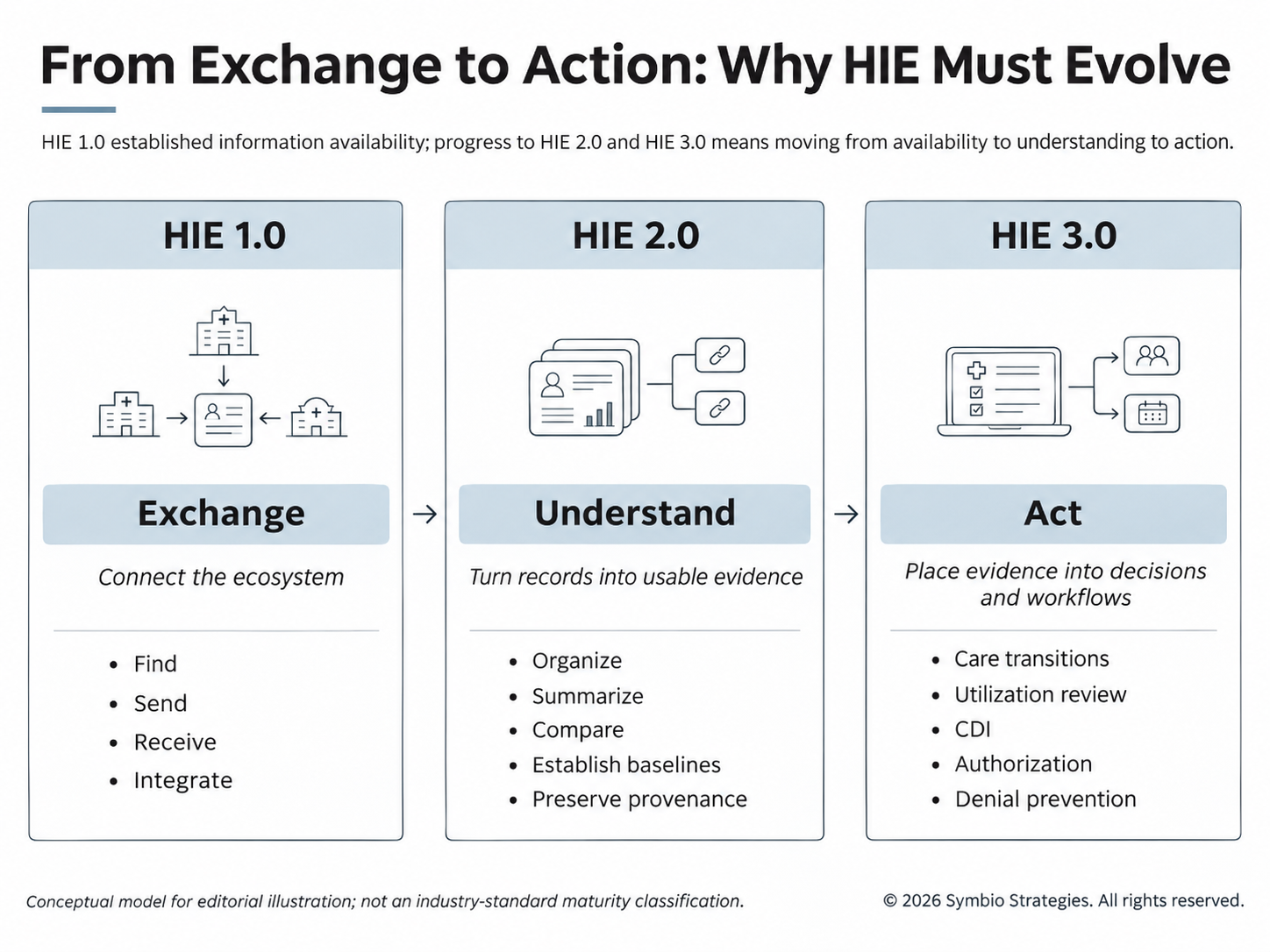
From exchange to intelligence infrastructure.
HIE 1.0 connects the ecosystem: find, send, receive, integrate. HIE 2.0 makes longitudinal information understandable: organize, summarize, compare, establish baselines, preserve provenance. HIE 3.0 makes it actionable: place validated evidence into care transitions, utilization review, clinical documentation, authorization, denial prevention, and population-health workflows.
The strategic asset is a cross-organizational view that no single EHR possesses. The opportunity is to transform that asset into timely, evidence-linked intelligence, not another destination for clinicians to visit.
Healthcare has spent decades building the infrastructure to exchange information. Yet clinicians, nurses, coders, case managers, and revenue-cycle teams still spend substantial time searching for and reconstructing evidence that may already exist elsewhere in the healthcare system.
AI should support physicians in making decisions about diagnoses, medical necessity, and appropriate billing, rather than making those decisions on its own. But it can change how humans find and evaluate the evidence for those decisions. The next era must convert fragmented data into evidence, evidence into decisions, and decisions into appropriate action.
The answeris to make them timely, accurate, contextual, and usable. Why must summarizing an electronically documented hospitalization remain such a manual cognitive task? Why must the recipient read the entire document simply to identify what changed?
We have built the infrastructure to exchange information. Now we must build the capability to act on it.
#healthcare interoperability, #AI in revenue cycle, #clinical documentation integrity
Symbio Strategies works with healthcare leaders to improve clinical effectiveness, operational integration, and health system performance. We bring together clinical, operational, and leadership expertise to help organizations address complex challenges, strengthen coordination, and translate strategy into sustainable improvements.
Let’s Connect
To explore your organization’s clinical transformation priorities or discuss the challenges raised in this article with Dr. Ednann Naz and our team, contact in*******@**************es.com.
Author info:
Ednann Naz, MD, MPH, MBA
Physician Executive | Clinical Operations + Mid-Revenue Cycle
Ednann focuses on connecting clinical operations, utilization management, and mid-revenue cycle to help health systems strengthen care delivery and performance.
Steph Sharma, DBA, G-MBA
Managing Director, Systems Strategy, Integration + Governance
Steph advises senior leaders in healthcare, leadership governance, and decision systems. She founded the company in 2011, with a rebrand in 2018.
references
References
Arndt, B.G., Micek, M.A., Rule, A., Shafer, C.M., Baltus, J.J. and Sinsky, C.A. (2024) ‘More tethered to the EHR: EHR workload trends among academic primary care physicians, 2019–2023’, Annals of Family Medicine, 22(1), pp. 12–18. https://doi.org/10.1370/afm.3047
Centers for Medicare & Medicaid Services (CMS) (2024) CMS Interoperability and Prior Authorization Final Rule (CMS-0057-F). 17 January. Available at: https://www.cms.gov/newsroom/fact-sheets/cms-interoperability-prior-authorization-final-rule-cms-0057-f
Healthcare Financial Management Association (HFMA) (2021) Standardizing denial metrics for revenue cycle benchmarking and process improvement. Available at: https://www.hfma.org/guidance/standardizing-denial-metrics-revenue-cycle-benchmarking-process-improvement/
Hersh, W.R. et al. (2015) ‘Outcomes from health information exchange: systematic review and future research needs’, JMIR Medical Informatics, 3(4), e39. https://doi.org/10.2196/medinform.5215
Holmgren, A.J., Adler-Milstein, J. and Apathy, N.C. (2024) ‘Electronic health record documentation burden crowds out health information exchange use by primary care physicians’, Health Affairs, 43(11), pp. 1538–1545. https://doi.org/10.1377/hlthaff.2024.00398
Jung, H.Y., Vest, J.R., Unruh, M.A., Kern, L.M. and Kaushal, R. (2015) ‘Use of health information exchange and repeat imaging costs’, Journal of the American College of Radiology, 12(12, Part B), pp. 1364–1370. https://doi.org/10.1016/j.jacr.2015.09.010
Kahl, N.M. et al. (2026) ‘Evaluation of electronic health record-integrated artificial intelligence chart review’, npj Health Systems, 3, Article 6. https://doi.org/10.1038/s44401-025-00064-x
Kleinig, O. et al. (2025) ‘Time for a rethink? Discharge summary completion is often delayed and associated with increased readmission’, Internal Medicine Journal, 55(9), pp. 1575–1577. https://doi.org/10.1111/imj.70150
Kroth, P.J. et al. (2019) ‘Association of electronic health record design and use factors with clinician stress and burnout’, JAMA Network Open, 2(8), e199609. https://doi.org/10.1001/jamanetworkopen.2019.9609
Menachemi, N., Rahurkar, S., Harle, C.A. and Vest, J.R. (2018) ‘The benefits of health information exchange: an updated systematic review’, Journal of the American Medical Informatics Association, 25(9), pp. 1259–1265. https://doi.org/10.1093/jamia/ocy035
Nijor, S., Rallis, G., Lad, N. and Gokcen, E. (2022) ‘Patient safety issues from information overload in electronic medical records’, Journal of Patient Safety, 18(6), pp. e999–e1003. https://doi.org/10.1097/PTS.0000000000001002
Office of the National Coordinator for Health Information Technology (ONC) (2024) Interoperable exchange of patient health information among U.S. hospitals: 2023. Data Brief No. 71, May. Available at: https://healthit.gov/data/data-briefs/interoperable-exchange-patient-health-information-among-us-hospitals-2023/
Office of the National Coordinator for Health Information Technology (ONC) (2026) Electronic health information exchange by hospitals. Health IT Quick Stat No. 66. Updated February. Available at: https://healthit.gov/data/quickstats/electronic-health-information-exchange-hospitals/
Patterson, B.W., Hekman, D.J., Liao, F.J., Hamedani, A.G., Shah, M.N. and Afshar, M. (2024) ‘Call me Dr Ishmael: trends in electronic health record notes available at emergency department visits and admissions’, JAMIA Open, 7(2), ooae039. https://doi.org/10.1093/jamiaopen/ooae039
Verma, R. et al. (2025) ‘Verifiable summarization of electronic health records using large language models to support chart review’, medRxiv [Preprint], 3 June. https://doi.org/10.1101/2025.06.02.25328807
You, A.X. et al. (2026) ‘Artificial intelligence note summarization in the emergency department’, JAMA Network Open, 9(6), e2618021. https://doi.org/10.1001/jamanetworkopen.2026.18021