


What air traffic control reveals about clinical operations, coordination, and the need for system-level coordination.
At busy periods, about 5,000 aircraft can be moving through U.S. skies at the same time. Each day, the Federal Aviation Administration provides air traffic services to more than 45,000 flights carrying 2.9 million passengers across more than 29 million square miles of airspace (Federal Aviation Administration, 2026).
Each pilot is responsible for an aircraft. Air traffic control maintains separation among aircraft and coordinates traffic across airports, routes, weather, congestion, emergencies, and changing capacity. At the national level, the FAA's Air Traffic Control System Command Center balances traffic demand with available capacity across the system (Federal Aviation Administration, 2025).
Commercial airlines completed 38.7 million flights worldwide in 2025. IATA recorded 51 accidents, eight of them fatal; across 2021 through 2025, the average was one fatal accident for every 5.6 million flights (International Air Transport Association, 2026). That safety record reflects a system built around engineering, training, standards, reporting, investigation, and coordination. Air traffic control is one part of that system.
Now consider the operating environment inside a hospital.
A patient moves through decisions made by physicians, nurses, pharmacists, therapists, case managers, diagnostic teams, utilization teams, bed management, staffing functions, and others. Each role holds information and responsibility that affects what can happen to the patient and when. Each sees part of the patient and part of the system.
A hospital can hold thousands of data points about a patient while the people caring for that patient carry different understandings of what is happening. Expert performance within each role leaves a second task: creating a shared picture across the hospital. Operational coordination depends on a shared understanding of why the patient is here, what is happening now, what the clinical team is doing, how the patient is responding, what is preventing the next step, and what needs to happen next.
We call that the patient story.
Pilots retain responsibility for operating their aircraft. Controllers maintain a view across aircraft, routes, constraints and changing conditions so that local decisions remain coordinated within the larger system.
Clinical expertise remains at the bedside. A hospital also requires the capacity to see across patients, teams, units, constraints, handoffs and resources while care is being delivered.
Are those parts of the hospital operating from the same picture?
clinical effectiveness and clinical operational integration
Beginning in the early 2010s, we worked together on a clinical transformation model within a regional health system in Central California. The work connected bedside care with clinical documentation, patient flow, utilization, resource management, revenue-cycle functions, service recovery, and system-level coordination.
We use clinical transformation to describe two connected dimensions of this work. Clinical effectiveness concerns whether the patient receives the right care and how that care performs. Clinical operational integration concerns whether the people, information, resources, decisions, and actions surrounding that care function as a connected system. A command center is one operating expression of that integration.
At the bedside, clinicians diagnose, treat, monitor, and respond based on the patient's condition, available evidence, clinical judgment, and response to treatment. Around that care, the hospital is coordinating beds, specialist access, imaging, procedures, staffing, discharge planning, authorization, transportation, and placement.
No individual clinician or department can see all of those conditions from a single point in the system.
A pilot can make the correct decision for one aircraft while the larger system accounts for other aircraft, routes, constraints, and changes around it.
A physician can make the correct decision for one patient while the hospital manages whether the resources, information, people, and actions required to carry out that decision are aligned.
air traffic control works from a shared picture
Air traffic control depends on visibility beyond any single aircraft. Controllers maintain separation between aircraft and communicate directly with pilots about traffic and conditions around them. Traffic managers work across a broader field, considering how weather, congestion, emergencies, runway constraints, and other disruptions in one part of the system affect traffic elsewhere. The FAA's national Air Traffic Control System Command Center coordinates traffic demand against available capacity across the system (Federal Aviation Administration, 2025).
Aviation has a term for the understanding that makes those decisions possible: the picture.
Air traffic controllers use “the picture” to describe their understanding of the current and anticipated traffic situation. It draws on radar, flight plans, communication, aircraft position, expected movement, and information from other controllers. Decisions depend on maintaining that picture as conditions change (Niessen and Eyferth, 2001).
Hospitals also produce continuous streams of information. Vital signs, laboratory results, imaging, orders, medications, physician notes, nursing documentation, bed status, staffing, utilization information, discharge planning, and payer requirements all describe part of what is happening.
Access to data does not mean that everyone is working from the same understanding. A patient can be clinically improving while discharge remains blocked. A bed can appear available while staffing prevents its use. A treatment plan can be clear to the physician while case management, utilization review, or the next care setting lacks the information required to act.
A shared operating picture connects the patient’s clinical condition with what needs to happen next, what is preventing that next step, who owns the action, when it is expected to occur, and when escalation is required.
A hospital can hold thousands of data points about a patient and still lack the operating picture required to coordinate care.
the patient story is the bridge
The medical record contains data about the patient. The patient story turns those data into a shared current understanding that clinical and operational teams can use.
It answers a set of questions that clinicians and operational teams repeatedly need to answer: Why is the patient here? What is happening now? What evidence supports the assessment? What are we doing? How is the patient responding? What still requires this level of care? What needs to happen next?
The story also includes information that determines whether the next step can occur: the barrier, the person responsible for addressing it, the expected completion, and the point at which escalation is required.
Different members of the care team can hold accurate information and still be working from different pictures of the patient. A physician may see clinical improvement. A nurse may know that the patient still requires oxygen. A case manager may be waiting for post-acute placement. Utilization review may need clearer documentation of continued medical necessity. Bed management may know that another patient is waiting for the bed.
These views describe different conditions affecting the same patient's care. Coordination requires them to be visible together.
Figure 1. The shared picture between bedside care and system coordination
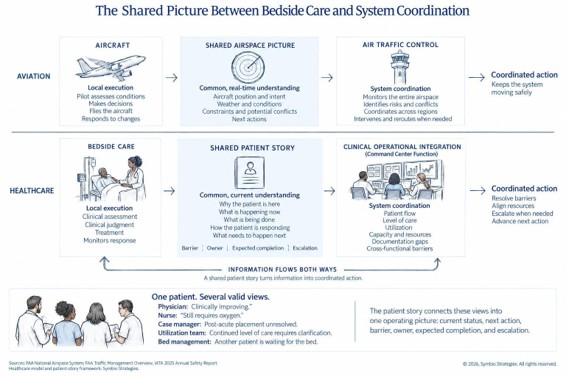
Source: Symbio Strategies, 2026, Kestner, M., Naz, E. Aviation concepts informed by Federal Aviation Administration air traffic management materials.
Documentation across physicians, nurses, case managers, utilization teams, and other functions often reflects the perspective of each discipline. When those perspectives remain separate, someone downstream has to reconstruct what happened, determine the current state, and identify what remains unresolved. We encountered this repeatedly in our clinical transformation work.
A shared patient story connects the clinical condition with the actions required around the patient. It allows the organization to see where care is progressing, where it is waiting, and where intervention is required.
Before a hospital can coordinate action, it has to coordinate meaning.
when the system cannot coordinate, patients wait
The effects of fragmented coordination are easiest to see in the waiting.
A patient has been admitted from the emergency department, but no inpatient bed is available. The bed may exist on paper while the unit lacks the staffing to open it. Another patient upstairs is medically ready to leave, but transportation, home oxygen, a post-acute placement, a medication, or a final decision is still unresolved. That patient remains in the bed. The admitted patient remains in the emergency department, sometimes for hours, while new patients continue to arrive.
The delay does not stay in one place.
Emergency department boarding consumes space needed for incoming patients. It changes where nurses and physicians deliver care and can delay tests, medications, transfers, and access to the teams and environments patients need after admission. A 2026 systematic review of U.S. studies found prolonged emergency department boarding associated with treatment delays, medication errors, longer stays, morbidity, and mortality, while also identifying the need for stronger prospective, multicenter evidence (Dowling et al., 2026).
The Joint Commission now places patient flow alongside handoff communication, timely critical-test reporting, and recognition of changes in a patient's condition within its national safety requirements. Hospitals are expected to measure boarding, set goals for managing it, review results, and act when patient-flow goals are not met (The Joint Commission, 2025).
Fragmentation also appears later in the mid-revenue cycle. A physician may have made the clinical decision, but the documentation may not explain why the patient still requires an inpatient level of care. Utilization review asks for clarification. A clinical documentation specialist queries the record. A payer may later ask for evidence after the care has already been delivered.
Downstream revenue-cycle failures can begin upstream, while care is still being delivered. HFMA denial categories include medical necessity and level of care, insufficient clinicals, DRG downgrades, and authorization; clinical-validation audits can take months or years to adjudicate and resolve (HFMA, n.d.; American Hospital Association, 2024). When clinical reasoning, level-of-care justification, authorization status, or an unresolved utilization concern is not made visible and addressed during care, the financial consequence may appear later. A denial can be the financial expression of an upstream clinical or operational failure.
Or the clinical plan is complete, but the next action has no clear owner. The test waits. The consult waits. The family waits. The discharge waits. The bed waits.
This is also what health systems are trying to address when they invest in command centers.
In a national survey of 25 operating hospital capacity command centers, 24 identified reducing emergency department boarding as a reason for implementation. Bed management and interhospital transfers were the most common functions. Eighteen tracked financial return on investment, and all 18 reported a positive return (Franklin et al., 2023).
A command center gives the hospital a place to see these conditions together: the patient waiting downstairs, the bed waiting upstairs, the barrier holding the discharge, the staffing constraint, the documentation or utilization question, and the person who can act.
Weather, mechanical problems, congestion, and emergencies remain part of aviation. Air traffic control gives the system a way to see those conditions across the airspace and coordinate a response.
Clinical complexity, demand, staffing constraints, and unexpected changes remain part of hospital care. Hospitals can build the operating capacity to see across those conditions and intervene before another disconnected delay becomes the next patient's wait.
the system needs a common language
A shared operating picture depends on people describing the patient and the work around that patient in ways others can understand and use.
Physicians, nurses, case managers, utilization teams, and operational leaders see different parts of the patient's care because they are responsible for different parts of it. Different roles still depend on a common way to understand and act on the patient story.
For the clinical record, Ednann describes a consistent expectation for what the record needs to communicate: What is wrong with the patient? What evidence supports that assessment? What is the clinical thinking? What is being done? How is the patient responding? What still requires the current level of care? What needs to happen next?
That information allows another clinician to understand the current state without reconstructing it from fragments. It also gives case management, utilization review, documentation specialists, bed management, and other teams the information they need to act.
That same principle extends beyond documentation. In our work, variation in process, documentation, communication, and environment interfered with coordination.
Processes establish how work moves and when intervention occurs. Documentation creates a common record of the patient's condition and plan. Communication determines how changes, barriers, and decisions move across people and teams. The environment determines whether the same information can be understood and acted on as the patient moves through different units and levels of care.
Clinical judgment remains individual. The standard applies to the information the system needs to understand.
A physician can exercise clinical judgment while the organization maintains common expectations for how that judgment becomes visible. Nursing, case management, utilization, and other functions can contribute their own perspectives while the broader patient story remains recognizable across the system.
Without that common language, every transition creates another opportunity for interpretation, clarification, and delay.
A common patient story moves with the patient. Clinical teams retain responsibility for care, while the coordinating function sees across patients, departments, barriers, and resources.
the command center coordinates across the system
In our work, the command center was built to see across the hospital while care was happening.
It brought together clinical documentation, patient flow, utilization, resource management, revenue-cycle activity, service recovery, and escalation. These functions already existed in the organization. The command center connected them around the same current picture of the patient and the operating conditions around that patient.
A command center brings patient status, barriers, capacity, documentation and utilization questions, and resource constraints into the same field of view. Each function may be doing its work while the patient still waits for the system around that care to align.
Who is waiting? What is preventing the next step? Who owns the barrier? What resource is constrained? What decision is pending? When does the issue require escalation?
The dashboard makes the problem visible. The command-center function connects that visibility to the people, decisions, resources, and escalation required to act.
In the model we developed, that meant reviewing patient status throughout the day, identifying avoidable delays, coordinating placement, examining documentation and utilization questions, monitoring capacity, and escalating issues that could not be resolved within the usual workflow.
Individual departments see the work assigned to them. The coordinating function sees the dependencies among them.
authority and leadership make coordination possible
A barrier can be visible across the organization and still remain unresolved. Ownership, authority, and escalation determine whether the organization can act on what it sees.
The command center depends on clear authority to escalate, convene, and move decisions across departmental boundaries. Without that authority, the organization can identify the same delay repeatedly while responsibility remains dispersed.
In our model, the command center did not replace clinical judgment or departmental leadership. It created a defined path for issues that could not be resolved within the usual workflow.
Executive leadership is integral to that authority. The executive sponsor does more than approve the command center or provide resources for it. That leader establishes a different expectation for how the organization will operate: barriers that cross functions will be visible, ownership will be clear, escalation will be expected, and departments will work from a shared view of the patient and the system.
This changes the culture of operating. Leaders are asking people who have been accountable for their own functions to become accountable for how those functions connect. Information that once remained within a department becomes part of a shared operating picture. Problems that move across teams acquire an owner and an escalation path.
Governance gives that expectation structure. The organization defines what the command center can see, what it can escalate, who is accountable for responding, and what happens when a barrier remains unresolved.
The operating model also has to survive beyond the people who first built it. In our work, recurring failures and shortfalls were reviewed to identify where process, communication, documentation, or the operating environment needed to change. Resolving today's barrier also created information about what the system needed to change for tomorrow.
We will return to executive sponsorship, governance, accountability, and the leadership behaviors that make this operating model sustainable in a subsequent article.
from shared visibility to coordinated action
Healthcare has drawn on air traffic control before. In 2009, Hoskins and colleagues tested an intrahospital mass-casualty tracking system built from air-traffic-control methods. The approach improved the accuracy of patient tracking compared with the conventional clipboard method (Hoskins et al., 2009). In 2015, Newton and Fralic examined transfer systems across 10 tertiary-care centers and described bed management as similar to air traffic control: multiple streams of patients converge, scarce resources must be assigned, and movement has to be coordinated across the system (Newton and Fralic, 2015).
Johns Hopkins opened its capacity command center in 2016. By then, our clinical transformation work in Central California had been integrating many of the same functions for several years. Its published model combined real-time information, a system-wide view of hospital capacity, predictive analytics, standard work, rules for intervention, and a clear chain of command (Kane et al., 2019).
Since then, command centers have moved further into health-system operations. A 2023 U.S. benchmarking study documented 25 operating hospital capacity command centers, with most focused on emergency department boarding, bed management, transfers, and patient flow (Franklin et al., 2023). A 2024 review identified 73 publications describing healthcare command and coordination centers; 71% described physical centers and 29% described virtual models, spanning daily operations, surge management, emergency response, and mass-casualty management (Paterson et al., 2024).
We keep returning to air traffic control because the comparison exposes something healthcare organizations can miss when they focus on individual workflows, departments, or technologies.
Air traffic control creates an operating layer across aircraft while pilots remain responsible for flying. It maintains a current picture, applies common rules, anticipates constraints, coordinates scarce capacity, communicates changes, and intervenes when conditions around one aircraft affect the larger system.
Clinical expertise remains distributed across physicians, nurses, pharmacists, therapists, case managers, and other professionals. Operational expertise also remains distributed across bed management, staffing, utilization, documentation, revenue cycle, transport, environmental services, and other functions. Operating excellence depends on connecting those forms of expertise while the work is occurring.
for leaders, this translates into a small set of operating disciplines
Build a shared operating picture. The organization needs a current view of the patient, the next action, the barriers around that action, available capacity, and conditions elsewhere in the system that affect what can happen next.
Create a common operating language. Clinical judgment remains individual. The organization needs enough consistency in process, documentation, and communication for another part of the system to understand the current state and act on it.
Connect visibility to ownership. A visible delay without an owner remains a delay. Barriers need an accountable person or team, an expected resolution, and an escalation path.
Give the coordinating function authority. The command center has to be able to convene functions, escalate unresolved barriers, and move decisions across boundaries that individual departments cannot cross alone.
Treat leadership as part of the infrastructure. An executive sponsor establishes that coordination across the system is part of how the organization will operate. The cultural shift is from optimizing individual functions to taking responsibility for the dependencies among them.
Use technology to extend the operating model. Dashboards, predictive tools, and automation can increase what the organization can see and how quickly it can respond. Their value depends on the processes, information, decision rights, and accountability around them.
artificial intelligence and the operating model
As healthcare organizations explore AI-supported synthesis, prediction, and workflow coordination, the operating model remains the foundation. Agentic systems may participate in tasks and workflows within defined boundaries and human oversight.
The operating foundation still requires a defined patient story, ownership of the next action, escalation rules, and authority to intervene. Additional intelligence layered onto ambiguity leaves that ambiguity in place.
Air traffic control offers a useful comparison because aviation built coordination into the operating system before technology expanded the speed, scale, and precision of that coordination.
Our next article will examine what AI and agentic systems can add once that operating foundation exists.
AUTHOR BIOS
Mark S. Kestner, MD, MBA, is a physician executive and clinical transformation leader with more than three decades of experience across health-system leadership, surgery and critical care, operational redesign, quality, clinical integration, and healthcare technology. In the early 2010s, he helped develop an early clinical command-center model within a regional health system in Central California. His work at Symbio focuses on clinical operations, patient flow, governance, and health-system transformation.
Ednann Naz, MD, MPH, MBA, is a physician executive whose work connects clinical operations, physician engagement, documentation, utilization management, patient flow, and the mid-revenue cycle. He helped develop and expand the clinical-transformation and documentation work supporting an early hospital command-center model in Central California. At Symbio, his work focuses on clinical operational integration, the patient story, utilization, documentation, and revenue-cycle performance.
Steph Sharma, DBA, MBA, is Managing Director of Symbio Strategies, where her work focuses on systems strategy, integration, governance, organizational behavior, and decision-making under complexity. She advises healthcare leaders on how clinical, operational, technological, and organizational systems interact, with particular attention to responsible AI adoption, leadership, governance, and sustained organizational change.
references
American Hospital Association (2024) ‘Clinical Validation Audits and the Impact on Hospitals and Health Systems’, Advancing Health podcast, 25 September. Accessed 2 October 2026.
Dowling, M.K., Farmer, S., Dixit, S., Taylor, N., Chollet-Hinton, L., Tang, A., Powell, E. and Michael, S.S. (2026) ‘Patient and staff safety implications of emergency department boarding: a systematic review’, Health Affairs Scholar, 4(5), qxag084. DOI: 10.1093/haschl/qxag084.
Federal Aviation Administration (2025) ‘Traffic Management Overview’. U.S. Department of Transportation. Updated 2 April 2025. Accessed 2 October 2026.
Federal Aviation Administration (2026) ‘National Airspace System’. U.S. Department of Transportation. Updated 22 May 2026. Accessed 2 October 2026.
Franklin, B.J., Yenduri, R., Parekh, V.I., Fogerty, R.L., Scheulen, J.J., High, H., Handley, K., Crow, L. and Goralnick, E. (2023) ‘Hospital capacity command centers: a benchmarking survey on an emerging mechanism to manage patient flow’, Joint Commission Journal on Quality and Patient Safety, 49(4), pp. 189–198. DOI: 10.1016/j.jcjq.2023.01.007.
Healthcare Financial Management Association (HFMA) (n.d.) ‘Standardizing denial metrics for revenue cycle benchmarking and process improvement’. Accessed 2 October 2026.
Hoskins, J.D., Graham, R.F., Robinson, D.R., Lutz, C.C. and Folio, L.R. (2009) ‘Mass casualty tracking with air traffic control methodologies’, Journal of the American College of Surgeons, 208(6), pp. 1001–1008. DOI: 10.1016/j.jamcollsurg.2009.02.044.
International Air Transport Association (2026) ‘IATA Releases 2025 Safety Report’, 9 March. Accessed 2 October 2026.
Kane, E.M., Scheulen, J.J., Püttgen, A., Martinez, D., Levin, S., Bush, B.A., Huffman, L., Jacobs, M.M., Rupani, H. and Efron, D.T. (2019) ‘Use of systems engineering to design a hospital command center’, Joint Commission Journal on Quality and Patient Safety, 45(5), pp. 370–379. DOI: 10.1016/j.jcjq.2018.11.006.
Newton, S.M. and Fralic, M. (2015) ‘Interhospital transfer center model: components, themes, and design elements’, Air Medical Journal, 34(4), pp. 207–212. DOI: 10.1016/j.amj.2015.03.008.
Niessen, C. and Eyferth, K. (2001) ‘A model of the air traffic controller’s picture’, Safety Science, 37(2–3), pp. 187–202. DOI: 10.1016/S0925-7535(00)00048-5.
Paterson, E., Chari, S., McCormack, L. and Sanderson, P. (2024) ‘Application of a human factors systems approach to healthcare control centres for managing patient flow: a scoping review’, Journal of Medical Systems, 48, article 62. DOI: 10.1007/s10916-024-02071-1.
The Joint Commission (2025) ‘National Performance Goal #1: Right Patient, Right Care’. Accessed 2 October 2026.
report.
Meadows, D.H. (2008) Thinking in Systems: A Primer. White River Junction, VT: Chelsea Green Publishing.
Steph Sharma
Founder, Symbio Strategies
Steph advises senior leaders in healthcare, leadership governance, and decision systems. She founded Symbio Strategies in 2018.